Barry Le Va
Barry Le Va, a leading practitioner of Process, post-Minimal, and post-studio art whose sculptures and instal-
lations investigated the order of chaos and vice versa, has died at age seventy-nine, according to New York’s
David Nolan Gallery, which represents the California-born artist. Gaining renown in the 1960s with innovative
sculptures that he called “distributions,” in which a variety of materials were dispersed on the floor, Le Va was
seemingly influenced more by mystery novels than by traditional art history, and helped redefine the medium of
sculpture through his explorations of procedure, unconventional materials, two-dimensional space, imperma-
nence, and chance.
Born in Long Beach, California, in 1941, Le Va studied art and architecture at California State University, the
Los Angeles College of Art & Design, and Otis Art Institute of LA County, where he received his master’s de-
gree in 1967. A year later, he began executing his distributions, defined by the artist as “relationships of points
and configurations to each other.” In November 1968, a year before his first solo show, Le Va’s project—a break-
through alternative to the fabricated perfectionism of Minimalism—was announced on the cover of Artforum,
which showed a floor-bound distribution of shreds and strips of felt. “What happens to the spectator’s perceived
relationship to his environment when it is made to appear chaotic in one degree or another is the essence of
what Le Va’s recent work is about; all other issues are residual,” concluded Jane Livingston in the issue’s cover
story. “Whether the experience offered is felicitous or not, it is revelatory.”
In 1969, Le Va staged his first solo exhibition at the Walker Art Center, Minneapolis, in 1969. That same year,
his Omitted Section of a Section Omitted, 1968–69—a distribution of flour carefully dusted onto the floor—ap-
peared in the Whitney Museum of American Art’s “Anti-Illusion: Procedures/Materials,” a watershed survey of
conceptual art that included Lynda Benglis, Bruce Nauman, Keith Sonnier, Eva Hesse, Richard Serra, and Robert
Morris, among others. Shattered glass, wooden dowels, chalk, meat cleavers, and spent bullets are among other
materials featured in Le Va’s distributions, which, like much of oeuvre, carry undertows of violence: The artist
sometimes referred to them as “crime scenes,” casting the viewer as a kind of detective. Although they are often
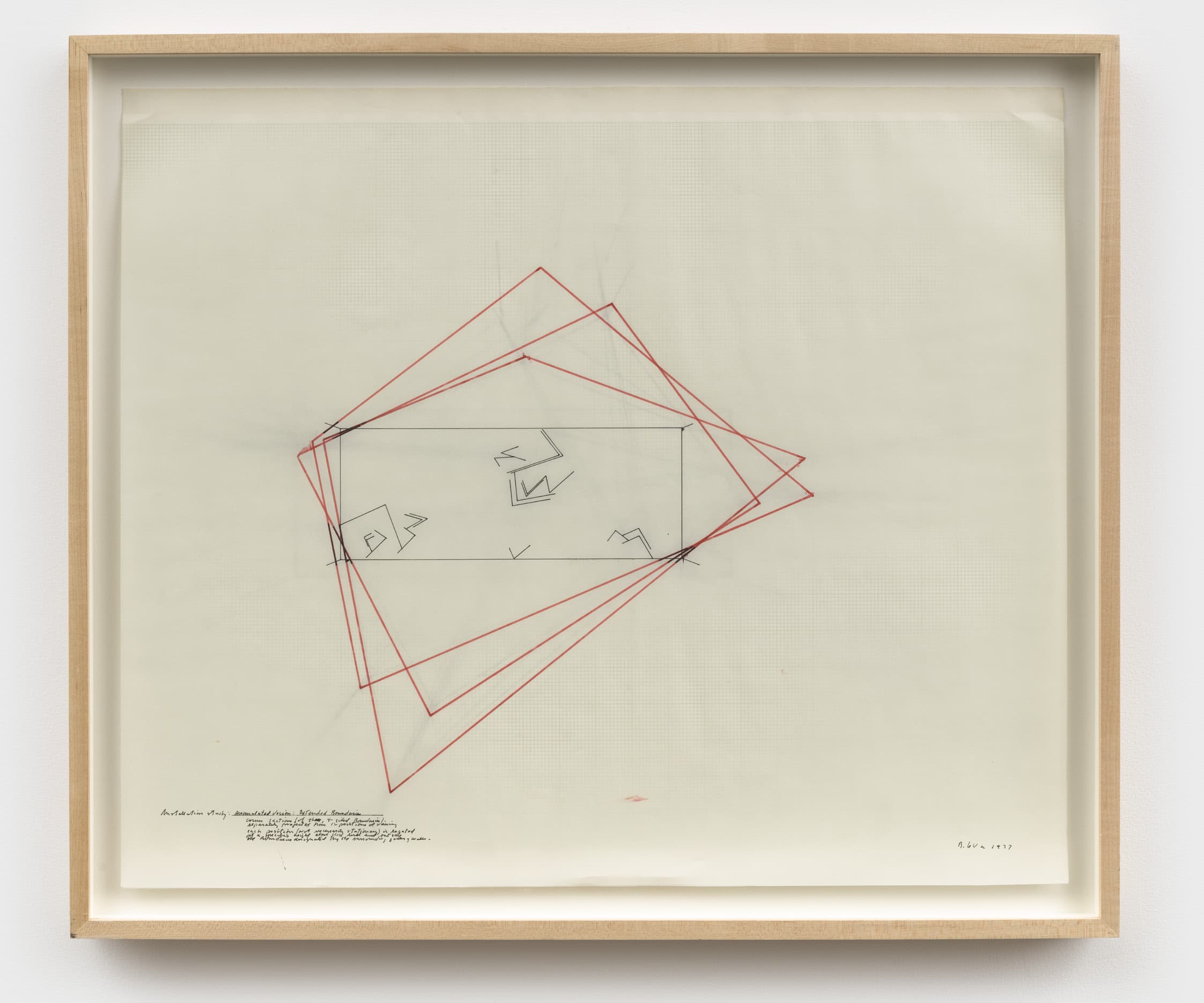
called “scatter pieces,” Le Va’s distributions relied on meticulous premeditation via drawings on paper, a vital
component of his practice.
In the 1970s, Le Va moved to New York, where he developed his interest in systems and networks, honing what
Carroll Dunham, writing in Artforum’s March 2005 issue, called an “aesthetic of emptiness,” one “in which
modest, unartful, or diminutive elements are used as analogues for mental processes.” The following decade saw
him furthering his interest in geometrical shapes and movement (as seen in Artforum’s January 1983 cover), and
over time critics began to note an increasing preoccupation with themes of mortality.
In addition to his more-than-five-decade studio practice, Le Va also taught at the Minneapolis College of Art &
Design, Princeton University, and Yale University. His art has been the subject of numerous exhibitions, includ-
ing three back-to-back editions of Documenta (1972, 1977, and 1982); “Barry Le Va, 1966 to 1988,” a retrospec-
tive at the Neuberger Museum; “Accumulated Vision,” a retrospective at Institute of Contemporary Art, Phila-
delphia (2005); “Greater New York at MoMA PS1, 20815–2016”; “Piece Work,” organized by Robert Storr at Yale
University School of Art; and an ongoing three-year exhibition at New York’s Dia:Beacon (2019–2021). His work
resides in the collections of major museums throughout the country, including the Museum of Modern Art in
New York and the Los Angeles County Museum of Art.
©Artforum
42