Loading…
Ossip Zadkine
b. 1888
Ossip Zadkine was born in Vitebsk, Russia, the same town as his contemporary, Chagall. Between 1905 - 1909
he traveled to London to study classical sculpture at the British Museum – a period that was to have a marked
impact on his later works, in particular the thirties gouaches. In 1910 he moved to Paris, later taking a room in
Montparnasse in the rue de Vaugirard in 1912-13, where he worked alongside many of the Ecole de Paris artists.
There he met Brancusi, Apollinaire, Lipchitz, Picasso, Matisse and Modigliani, who was to become a great friend
to Zadkine.
The term Ecole de Paris, referring to foreign artists working in Paris, roughly between 1910-1930 and specifical-
ly in Montparnasse, was coined in 1925 by the critic Andre Warnod. The school is today most often recognised
as the confluence of Jewish immigrant artists in the early 1900s with the emerging modernist aesthetic that had
essentially been transposed from Montmartre to Montparnasse.
The new generation of Jews in Eastern Europe were denied both freedom of movement and of expression and
access to higher education in arts in their home countries. Paris became an almost mythical city that represented
for them a refuge, a haven and a center for the arts, which could offer them not only the observance of human
rights but a better and more exciting way of life. There was an unsurpassable passion for art in this Jewish com-
munity at the turn of 20th century.
Zadkine’s early works reveal a great admiration for the expressive power of primitive art and an ability to adapt
its boldness and stark simplicity in his own work. From 1914 the influence mainly of Lipchitz led to his cubist
creations. These works translated the abstract character of cubist painting into shifting flat planes, angularity, and
contrasts of convex and concave areas, both in sculpture and in painting.
Towards the end of the decade and throughout the twenties and thirties, Zadkine enjoyed international suc-
cess with shows in Tokyo (Takanodai Gallery, 1922), Paris (Retrospective, Barbazanges Gallery, (1926), London
(1928), Chicago (Arts Club, 1930), Brussels, and New York (1937). Hailed as a hugely important and influential
European artist, the Museum of Modern Art in New York held a Zadkine retrospective in 1949. In 1961 the Tate
Gallery in London also held a seminal exhibition of his work, followed shortly after by a retrospective in the
Kunsthaus Zurich in 1965.
Whilst Zadkine was better known as a sculptor; primarily of deconstructed stone and wooden statues, striking
in their strongly geometric, closed forms; from around 1922 he worked on a number of gouaches, watercolors,
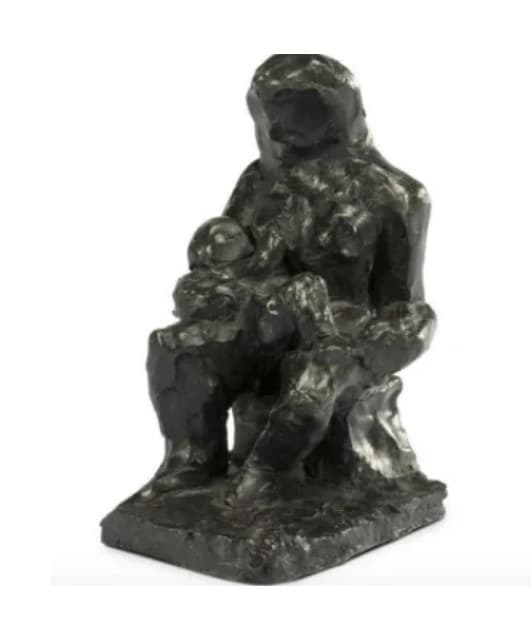
drawings and lithographs. ‘Maternité’, 1934, is an important example of the period: much of Zadkine’s art after
1930 contained neoclassical elements. An expert on Greco-Roman civilisation, he revered European culture, of-
ten utilizing elements to provide a complex narrative to his works. This is an exceptionally modern depiction of
an age-old subject: the tender love between a mother and child; rendered in the powerful and original style that
was to make Zadkine a major influence on twentieth century art.
©Artnet
138